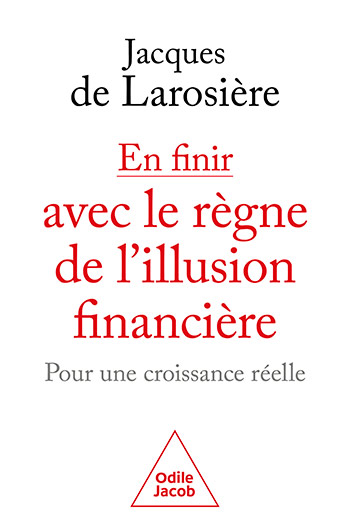
Jacques de Larosière
Putting an end to the reign of financial illusion : for real growth Date de parution : 7 septembre 2022
EAN13 : 9782415003784 / 144 pages / 145 x 220 mm / 400 g
EAN13 : 9782415003784 / 144 pages / 145 x 220 mm / 400 g
“We all know that our world has become very indebted over the past decades and that its ‘financialization’ has reached proportions never observed before, at least in peacetime.
But how serious is this phenomenon?
What are its consequences on the solidity of our financial system, on the functioning of our economy and on the future of our society?
Above all, we must understand how our world has surreptitiously changed its model for the past two decades. It has slipped to a strange paradigm, one in which the bulk of economic activity is now reflected in the rise in the value of financial assets at the expense of growth, wage income and productive investment.
It is time to put an end to the reign of illusion and to reinstate the fundamental economic springs without which there can be no real growth.” J. de L.
“No one alive today combines Jacques de Larosière’s experience with an acuity about global finance. His sharp and cogent expression of alarm in this timely volume deserves and even demands the attention of the global financial community.”
Lawrence Summers, Former Secretary of the United States Treasury and President Emeritus of Harvard
“This is a must-read for those who want to understand the ‘economic illusions’ hiding in plain sight. And for those who are prepared to step-up to the benefit of a new generation.”
Kevin Warsh, member of the Federal Reserve Board (2006-2018), and professor at Stanford
“The book is a harsh criticism of the fairy tales that have guided monetary theory and the actions of central bankers in recent decades.”
Vito Tanzi, Honorary President of the International Institute of Public Finance
Jacques de Larosière spent his entire career at the head of financial institutions: he was first Managing Director of the International Monetary Fund (1978-1987) before becoming Governor of the Banque de France (1987-1993), then president of the European Bank of Reconstruction and Development (1993-1998). He is currently Advisor to the president of BNP-Parisbas.
- Cover Page
- Title Page
- Copyright Page
- Introduction
- Chapter I - Where we see that the global debt has now reached the historical record of 300 trillion dollars
- Chapter II - Where we see that the global balance sheet has tripled in twenty years, which is unrelated to the evolution of real growth, which is much lower
- 1. First of all, it represents today the staggering amount of about 18 times the world GDP, thus marking an historical record
- 2. Second, we note that this global balance sheet has grown massively over the last 20 years: it has tripled
- 3. Net wealth has grown much faster than income
- 4. For 20 years, debt has exceeded investment
- 5. The “housing bubble” illustrates this phenomenon of nominal asset growth
- 6. Finally, let's look at the overall balance sheet during the pandemic
- Chapter III - The evolution of the global balance sheet illustrates the growing vulnerability of the financial system, the decline in productive investment, the low productivity of the economy and the intensification of social inequalities
- 1. First, the evolution of the global balance sheet reflects the decline in productive investment
- 2. Second, despite monetary ease, there are increasing tensions in the productive system
- 3. Thirdly, this explosion of the global balance sheet has been accompanied by a sharp increase in inequality
- Chapter IV - Where we see that the gap between financing (monetary and budgetary) and reality (GDP growth) is particularly pronounced in the Eurozone. This phenomenon has been aggravated by the health crisis
- 1. The pandemic hit the Eurozone harder than its main competitors
- 2. The use of demand stimulus has proven to be important in many Eurozone countries
- 3. A record level of public debt does not favor economic growth or employment
- Chapter V - A central question: “How can we explain the radical shift in monetary policy: From Stability to Permanent Stimulus?”
- 1. The accommodation of monetary policy in recent years has been literally unheard of
- Chapter VI - What should the ECB's monetary policy be in the current high inflation environment?
- 1. The anguish of Central Bankers: memories of the 1970s
- 2. The monetary dilemma in the event of an oil shock
- 3. The ECB's response: after a long period of hesitation and ambiguity it began to identify, in June 2022, the real problems
- 4. The ECB's inflation projection has been seriously revised to be more realistic in June 2022
- Chapter VII - Let's return to the global balance sheet and keep in mind what it tells us, about our growth model and its ability to meet the challenges of the future
- By way of conclusion - Where we see that one day reality will prevail and sound the end of the playground
- Annex
- Contents